Monday, September 24, 2012

Zambia, the “real Africa” with the man they call White Beard


TONY: Even though lonely planet had already warned me that Zambia was the ‘real africa’, whatever that meant, I have to admit that I got a fair jolt of culture shock in the cab from the airport to our hotel on the main street of Lusaka, the capital. That Zambia (then Northern Rhodesia) had been pillaged by the British for the benefit of its old neighbor Southern Rhodesia was evident from the poverty and lack of development. Having one of the highest percentages of HIV in the world was also evident, with signs everywhere promoting abstinence and offering protection. But once I’d got past that fact that we really seemed to be the only white people in the whole city, the friendliness and atmosphere soon shook the threatening feeling away.

My dad was meeting us at the hotel, and somehow the people at the desk knew immediately who I was looking for. Maybe we look a little bit similar. Dad was joining us for a trip to the South Luangwa National Park and some time on Zanzibar. Some people might think it’s a bit weird to have their dad join them for part of their honeymoon (as I write this it does seem a bit…) but we were excited as dads good company, very easy going and enthusiastic about new places.

The highlight of Lusaka was a walking tour of a “compound”, a sprawling suburb of shacks in that in other places might be called a township, a ghetto, or a slum. It might sound weird to talk about this as a highlight, and I wasn’t really comfortable with the idea of a “human safari” at first, but it was an amazing illustration of how the west has got it wrong. Everyone was really happy, really friendly, knew all their neighbors, and helped each other out. Of course it wasn’t perfect, there is crime, poverty, no sanitation, and I can verify that the community-brewed beer tastes like mud, but there is a sense of community that is missing from the suburbs of Melbourne.


Our accommodation in the South Luangwa national park, a tiny, shaky, prop-plane flight away from the capital, was everything we expected from the glowing recommendations. After arriving and checking into our enormous safari-style chalet, we sat at a table just outside the thatched-roof bar looking out over the African bush and the wide Luangwa river. Soon enough, an Elephant came crashing through the trees and ambled towards our table. Probably going for Julie’s exotic cocktail. The staff shouted at us to abandon our drinks and bags and make a dash for the covered area of the bar. They’re scared of elephants and apparently Stampy doesn’t like the ambiance of the covered areas of the lodge, even if they’re open on all sides. But he left our beers alone (unlike the monkeys, who took advantage of our absence to get stuck into the hard stuff on our expense) and proceeded to tear up the surrounding trees and generally make a racket. This was not a unique experience at the lodge, as during the next week we would see just as much wildlife in and around the lodge as we did driving and walking through the national park. Giraffes hung out outside our room, cheeky monkeys tried to steal my go pro, and crocs kept us from cooling off in the Luangwa. When I asked one of the staff why the Hippos always came up to the lodge after dusk, he said “oh yes, the Hippos, they love the sausages!”. (Imagine deep African drawl and a cheshire cat smile as it was dark at the time) I was confused. Did they have a new subspecies of carnivorous hippo in Zambia?  I realized later that he was referring to the funny looking “Sausage Fruit” a huge elongated fruit that grows on trees all over the place.
Elephants crossing the Luangwa river to tear up the villages crops

We spent an amazing week with “Dazzles” of Zebra, “Parades” of Giraffe... We saw a few Leopards including cubs, and even saw a huge brave/stupid baboon take a leopard on for the good of his group.

Leopard


The 48 hour train we took from Lusaka to Dar es Salaam, in Tanzania, could be another example of what you might call the “real Africa” except that it was built by the Chinese. It has been left to rot in disrepair in the decades since and I suspect it only runs on the collective will of the passengers to reach their destination and the sanitary plumbing they might find there. It was rough, loud, dirty and the food was suspect, but it travelled through some beautiful countryside. It also stopped in every small, isolated village it passed, where all the people of the village would crowd around with baskets of food balanced on their heads in an impromptu market. Kids came running for miles to wave at the ‘muzungu’ (us). 

Incredible. 

One of the many village markets around the train, this one selling mostly green bananas which are mashed together like potatoes as a staple food
Evening view from the train
Julie shopping at the marke

(JULIE- Just a word on the township tour in Lusaka. The little kids in the township (slum) were totally gorgeous and when our guide was telling us something would sidle up and smile cheekily.  I gave one a hi five and about 20 kids were pushing each other over to give me hi fives like I was the coolest thing in the world.  Then they’d want to hold my hand and dance around in a circle, and then another little kid would push in and grab my hand instead of the first one till we had a line of 10 kids going. They were so curious and sweet.  At one spot on the tour a local young man had tied a bunch of rags together to make a swing for the kids in a tree and a few of the bigger kids spent hours pushing the little ones on it – and the little kids all waited in line really patiently for their turn.  Imagine a line of 4 year olds in Australia (as if).   The tour guide also showed us a community project where a little shack was set aside as a sort of youth centre.  These boys would have been barely older than Rheeese (13) but were so proud of their centre.  They showed us their store room and their library, which seriosly had like 50 books (I immediately wanted to go out and buy them a truckload). They not only read them, but sit down and read the books to the little kids too. Anyway, the thing that was really nice was these initiatives came from within the community with barely any funding.) 


Monday, August 27, 2012

Sand and Granite


South Africa
TONY: After all the percolated coffee and dirty toilets in France, landing at Cape Town airport greeted with a soy latte and a clean loo felt like a return to civilization. I’ve always wanted to live in a place where you could surf in the morning before work and climb in the evening after, and Cape Town delivers that in the most beautiful location of any city I’ve ever been. It also has decent night life and excellent food, a mix of Asian, African and European and the best condiment known to man, Mrs H.S Balls Original Recipe Chutney (Laura: Julie thinks she’s seen it in your fridge at home. You NEED to put us in contact with your supplier!) Laura’s sister Jeanette kindly offered us a room in her apartment in Rondebosh, a leafy suburb close to everything, with a view of Table Mountain to wake up to every morning. She was great company and an excellent part time tour guide, and we saw a lot in the week we spent in an around the city. The highlight was probably the little seaside villages dotted across the peninsula, each with its own character and beach and mountain vista. Eating fresh seafood at sunset on the fisherman’s quay in Kalk Bay, watching the seals try to steal some of the last catch of the day while it’s being bought in by the colorful little fishing boats... There are also African penguins, and everyone knows I’ve got a soft spot for penguins. We climbed one of the classic table mountain routes, ‘Jacobs Ladder (16)’ in a single very long day. Julie lead most of the route, including the amazing traverse pitch. Climbing this steep cliff high above the town and the ocean was one of the highlights of the trip. 

Beautiful traverse pitch on Jacob's Ladder - with Cape Town below
Table Mountain with our lovely hostess Jeanett
Sad to leave Cape Town, we picked up a rental car, filled the boot with Biltong and headed north, through empty countryside to the Cerderberg Wilderness..  We starte to feel it was all a bit easy, just like home, and then we drove past Zebras (ZEBRAS!) We named our VW Polo ‘Von Smits’ to try to fit in with the Africaaners. The main attraction in Cederbeg, aside from the rolling hills and wildflowers, is the sandstone boulders, which attract scores of climbers from all over the world for months at a time. August is prime time for camping and bouldering at the ‘Rocklands’ when days are sunny and clear and friction is at its best.

At least, that’s what the guidebook I was reading insisted while we sat in the car watching the hail batter the windscreen. It was freezing, but thankfully only for a day or two, after which we got the sunny weather we were promised. We spent our one sunny day climbing with French, Germans, Russians, Czechs and Americans.  That night prompted by many a veteran Rocklands boulderer, we visited a fundraising performance at a primary school in a nearby village. The kids really put my primary school plays to shame with their incredible dancing and singing (although my family said my turn as ‘Trooper 4’ in ‘Captain Midnight’ at Castlemaine North Primary was inspired). Their choir covered a Ladysmith Black Mambazo track that I love, and traditional dancing was neat. The littlest kids were very cute in their enthusiasm.

Leaving the next day at 6, we made our way through South African and Namibian border checks; at least 6 windows to visit it turned out, but no one told us that until we tried to cross the border without some random stamp or fee paid or another. 
Tony in his element visiting endangered penguins on the Cape

Kirstenbosch Botanical Gardens in Cape Town


Fishermen bringing in our fish for dinner - check out the seal


Julie and our fish at chips at Kalkies, Kalk Bay Cape Town
Namibia
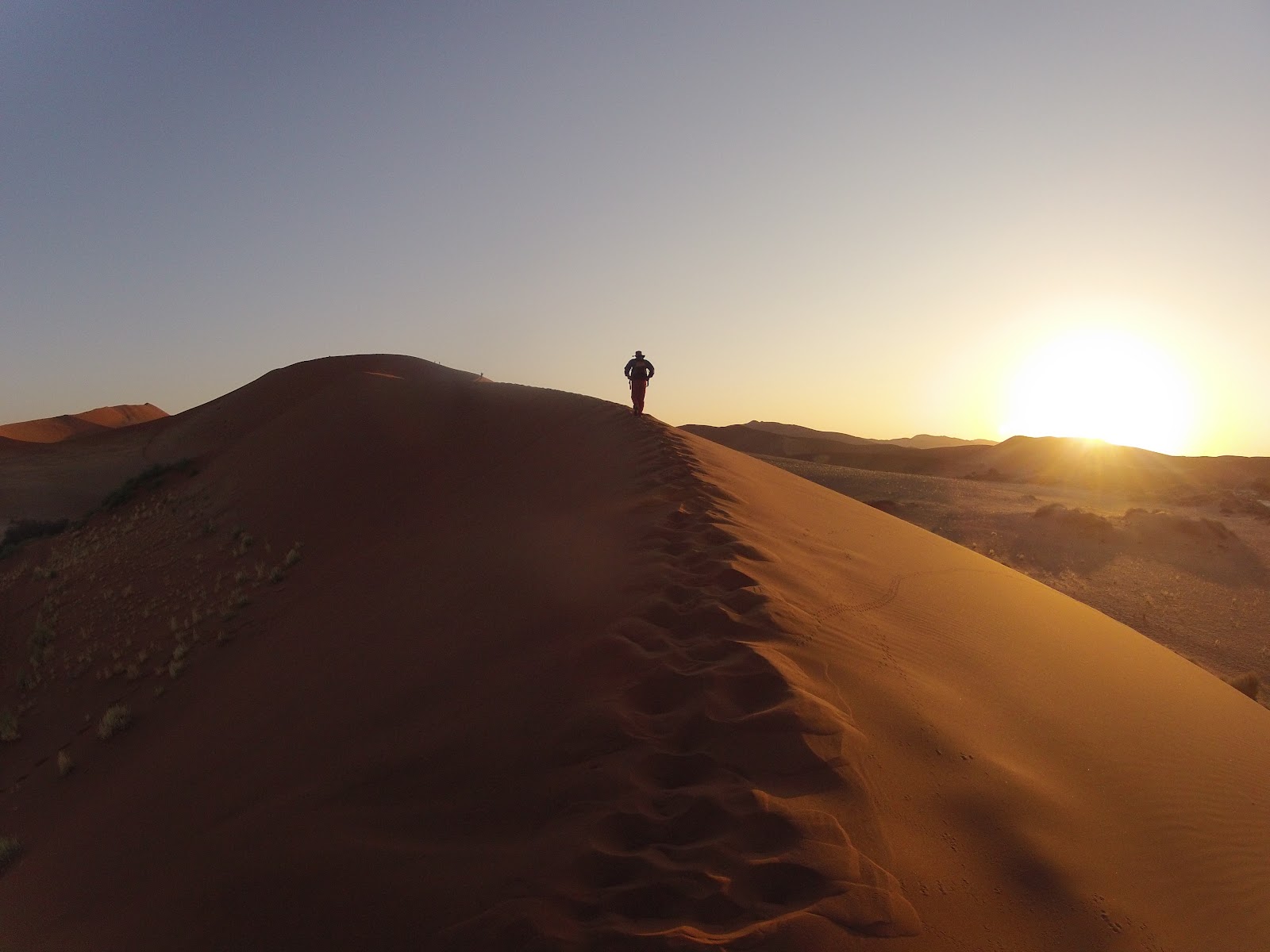
It was really started to feel like Africa. The roads were straights and dusty, junctions swarming with families looking for rides and shacks made from tin cans selling beaded necklaces and collected firewood. I’d expected to see African animals in game parks, but we were already spotting ostriches, warthogs, springbok and gemsbok in the early morning and late evening from the road. We traveled up through Namibia, which is really one vast desert stretching from the huge red sand dunes of the Namib to the plains of the Khalahari. There are many local languages, and we learnt how to say hello in the Nama language, one of the “clicking” languages, from a girl at a roadhouse. Not easy to pronounce, and I have no idea how to spell a click. (I think they use apostrophes !nama) We stopped each night to camp in the desert. The first night we camped close to Fish River Canyon, the second largest canyon in the world behind the Grand Canyon, and watched the sun go down on its edge. We visited the Namib Desert dunes at Sussouvlei, and hiked through the red emptiness reminiscent of Arabia to the Hidden Vlei, a mud flat with petrified trees 600 years old. The colors of the flat white ground against the deep red dunes and the bright blue sky were incredible. 

Fish River Canyon (and a tiny Julie)
We continued north, Von Smits grudgingly absorbing the dust, corrugations and potholes. We’d been told not to pick up locals looking for lifts, but it was getting increasingly difficult to drive past families with their thumbs out in the middle of nowhere, happy as they seemed to be waiting in the blazing sun. When we asked again at a service station about picking up hitch hikers, the friendly man was emphatic in his insistence that it was to be avoided, and we would be harassed or worse, but we had to question his real motives when he mumbled ‘you’ll never get the African stink out of the car’. We were happy the next day to give a lift to a friend of one of the park rangers to the city, who we found out later worked as a nurse in a healthcare system with 700 patients per doctor, 7 days a week at a workplace 8 hours drive from home. We arrived in Windhoek, the capital, for a days rest and to collect provisions for a week camping at Spitzkoppe, the “Matterhorn of Africa”.

Von Smits in Namibia

Soaking up the ambiance at the canyon
Our desert camp in Sossusvlei
The incredible Sossusvlei dunes in Namibia


The only shade for kms, under a 600 year old dead tree in Hidden Vlei

JULIE:
To give some idea of the aspect of Spitzkopppe, you might imagine a Namibian version of Ayres Rock, in the shape of the  Matterhorn – it’s a great reddy golden mountain and boulder playground rising from a vast dry plain.

Our arrival at Spitzkoppe marked 5 days or so of dawn starts, unheard of for Tony, and a veritable miracle for me.  We not only survived, but continued the trend of pre-sunrise starts to climb a few longer routes in Spitzkoppe (the sun sets early here in winter).  But I get ahead of myself.
3 hours into our drive from the capital,Windhoek our recorded book about the travels of Livingstone and Stanley finished. I tied up my work, my laptop died and I realised I’d forgotten to buy a new book. I was utterly dismayed, expecting that the desert blankness for5 days would get more than a little boring (Oh, how wonderful, more, sand). 

Ah but the desert won. My simple mind just couldn’t comprehend how a place so dry with 5mm of annual rainfall could support so much life.  A base level of intrigue made each new sight a discovery, a thing to ponder and the rock is beautiful, smooth and sinewy.  The rock here is ancient, truly.  Apparently created by volcanic action well before Gondwana was even created, the granite didn’t pierce the surface.  Over eons, first covered by glaciers, surrounding earth cleared, to reveal the granite now exposed to the sand. That there is nothing around to see in any direction compounds the sense you’ve moved back in time. (The local town is a mere smattering of tin shacks, home to gem stone miners, and sits near a dry riverbed kilometres away).

Camping among the boulders at Spitzkoppe. 
The guidebook describes the ambiance as ‘spiritual’; reading which made me mentally vomit.  But, there is something truly special about real silence in the desert I can appreciate.  Your body must, I think, sense the silence, and shut down even those tiny defences it retains even when you’re fully relaxed on, say, a beach holiday back home.  In the desert even your ears can relax.  And it’s true that the stars are more beautiful.  

I have to admit that I didn’t relax straight away.  As we entered the Spitzkoppe Park I read a happy report explaining conservation success attracting fauna to the park – including leopards.  I was shocked. In my head, all I had to watch our for were snakes near the rocks.  Snakes, being Australian, I can watch out for.  But I figure I’m snack size for a leopard, and definitely not able to intimidate one.  

Thus commences night one, a tiny desert mouse scuttled around near the tent.  I was sure it was a leopard.  Tony snored. I shuddered!  The Leopard would find us now for sure!  I was sure I’d look up to glowing Leopard eyes through the fly door.  Then a fierce wind picked up and whipped the tent so fiercely I couldn’t make out leopard sounds from the sandstorm.  Unfortunately the cold, strong, wind hounded most of our trip and limited our ability to climb the balancy slabs* somewhat, though we did scuttle up P. Hufagnel on the towering smooth buttress next to our camp on one sunny afternoon  .   

Tony contemplating the next run out on P. Hufagnel
Abseiling off P. Hufagnel
The access to the climbs were quite lovely too. For our most satisfying climb we had to start the walk in from the ground to the far right of the Pontok range and trend up the low angled slabs past each of the 4 big pontok mountains all the way to the leftmost Pontok Spitz. The path lead through a maze of boulder steps and corridors.  Along the way we saw mountain hyrax, and odd plants like cactus trees, spiky desert plants with delicate purple flowers. 

Admittedly slab climbing of the flavour in the area is not my ideal variant of the sport– I feel too much at the whim of brittle rock to commit to 4 metre+ run-outs.  Tony on the other hand boldly (as his wife, I may say somewhat too boldly)  loves to climb slab routes.  He lead us up the 8 pitch “To Bolt or Not To Bolt” on our final, perfect weather day.  New monikers aside (“To bolt a little more?”), we reached the summit marker in the sunshine and I was awfully glad we’d done it.  Our names are now in the Summit Book at the top, recording our battle up the glorious crux, thrutchy chimney,  off-width crack and brittle traverse pitches, on our honeymoon. 

We left a little sandy, but happy to wash off and relax in a comfy bed in the Capital.  We learnt a little from other guests in the thoroughly recommended Rivendell Guest House; Etosha Game park further north is apparently teeming with game, including black rhino and is beautiful, and we’ve been tipping at roughly 5 times the going rate all trip.

Currently sitting at the airport, where our first internal African flight from Namibia has been delayed for 6 hours for maintenance.  Namibia is very developed, and so I suspect this marks the start of our “real” African journey.   We’re off to Zambia now to stay in a game lodge for a week and then catch the Tazara train through Tanzania over and then hang out in the very, very, cool sounding Zanzibar (just rolls off the tongue doesn’t it) with Tony’s Dad.

(*Slabs are rough rock that is less than vertical you patter up based on friction alone. Physically easy, apart from on the calves, it’s scary as one slip and you’d likely grater down, quite far since often (and in Spitzkoppe generally) the relative ease of the climb means protection is well spaced 4-10 metres apart)

Tony Conqueror of Pontok Spitz


A hug on the summit of To Bolt or Not To Bolt- our final day.


Sunday, August 19, 2012

Summit Fever


Alpine rock climbing was something I was really excited about. Australia has some decent sized cliffs, but the Mont Blanc massif of the French alps has 800 meter granite climbs at high altitude above spectacular glaciers. I somehow talked Julie into going there.
Chamonix was a bit of a blur. We had to get oriented, find accommodation (overpriced) and buy a lot of gear. We rented ice axes and crampons, a bought a book called "how to cross glaciers" which I skimmed through over dinner by way of preparation. Pretty straightforward really; stay roped together, and if someone falls down a crevasse, try not to fall down after them. If you manage to stop their fall, somehow build an ice anchor and a three way pulley system to haul them out. The same as rock rescue really, except on ice. 

Our first goal was the Envers refuge, a small alpine hut perched above the Mer de Glace glacier below some incredible granite spires. We like to make an epic out of every trip we take, so we filled our bags with way too much food and equipment until we could barely carry them before taking the Montenvers alpine train to the highest point we could, roping up and setting out across the glacier.
Eleven hours later we finally saw the hut. I think our climbing ability and experience were more than sufficient for the alpine climbing we were preparing to attempt, but our fitness and speed were not. Two months of eating daily three course 'menu du jour' french meals, together with incredibly heavy packs, meant we set a record as the slowest approach to the Envers refuge in the history of Alpinism, and we could barely put one food in front of the other by the time we were climbing the iron ladders that guard the last few hundred meters to the hut. Evelyn the hut guardian/cook wasn't happy to be preparing our dinner at 10pm, and didn't stop frowning at us for three days. 

The climbing above the hut was absolutely stunning. Huge snow tipped granite towers surrounded by glaciers, split by long hand cracks perfect for lacing with gear. After our unnecessarily epic walk in, we spent a morning recovering before doing our first route, 'Magic of the Orient', a 500 Meter pair of towers above the Blantyre glacier. Being our first alpine climb we had a couple of teething problems. How do we keep the ropes dry belaying off the ice? How do we stop the packs from skating off down the ice slope while we climb? How do we get onto the rock when the glacier is separated from the rock by a bottomless crevasse? We figured it all out eventually and had a beautiful afternoon climbing in the sun..

Julie high above the Mer de Glace on 'Magic of the Orient'
The next day we attempted a route called ‘Guy-Anne’, a series of cracks that trace a path up the Pont de Nantillions, the sharp looking spires high above the Hut. The crux of the route is a perfect diagonal hand width crack which is a grade less than the previous pitch at 6a+ but feels incredibly hard after 60 meters of sustained hand jamming. We battled through it, but leading all pitches in succession was taking its toll on me, and again we were moving too slowly to finish before dark, so we retreated late in the day. We didn’t get another shot at it, as the weather closed in the next day and we were forced to hike back down to Chamonix. 

Celebrating that I survived the cracks of Guy Anne
After a couple of rest days hanging out in arty cafes by the canals in Annecy, we forgot about the suffering involved in Alpine climbing and made a dash back to the alps when the weather cleared, this time on the Italian side, for a shot at a route on the ‘Petit Capucin’, a peak on the flanks of Mont Blanc itself beside the incredible looking ‘Grand Capucin’. Unfortunately this meant spending a night or two in the ugly prison like Torino refuge, a concrete bunker that passes for a Refugio. It is one of the highest refuges in the Alps and a necessary staging point for people attempting to summit Mont Blanc or many of Valle Blanche routes. It’s dirty, cold and uncomfortable, and when we were trekking across the glacier in the Valle Blanche before sunrise the next day, I envied the group that had pitched tents out on the ice, surrounded only by the magnificent peaks.
Our route, ‘Lifting the King’, is a 10 pitch 400 meter 5c route, with some nice climbing in an absolutely breathtaking setting. Behind, the summit of Mont Blanc is clearly visible. To the right, the sheer face of the Grand Capucin looks intimidating, but is tempting at only 6a+ if you’re willing to pull out the etriers. In the distance, the ‘Giants Tooth’ cuts through the clouds. 
Julie in the Valle Blanche. Our goal is the middle of the three peaks on the left of the photo

When we arrived at the base of the route, a pair of Italians were just starting out. We were dismayed, thinking climbing up below them would slow us enough to miss out on the summit, but they couldn’t figure out the opening sequence of moves up a steep crack, and left defeated. With the peak to ourselves, we climbed more quickly, with each pitch falling in good time. Belaying, I could see another pair of climbers across the valley on another route, a tough looking, steep, parallel crack that wouldn’t look out of place at India Creek, Utah, if it wasn’t for all the snow and ice. Next time.
Julie on 'Lifting the King', high above the Valle Blanche
The climbing was technical in places, with thin slabs, steep corners occasional cracks. For most of the morning the sun was shining, but in the afternoon cloud started to form and a bitter cold wind built up until it was almost unbearable.  (Julie – liar! the wind started on pitch 3).  Belaying and rope handling became difficult with stiff shaking hands, and Julie was struggling to communicate as her jaw locked up from the cold. We were still four pitches from the summit, and the crux pitch is the final steep headwall to the peak. Then we still had to get down, 10 long abseils and a two hour+ trek across the glacier to the refuge, probably in the dark. I’m sure Julie would have bailed if she didn’t have to face my disappointed expressions, but we kept climbing.  Reaching the top of the route in the late afternoon, we snapped two photos, glanced at the view, and headed down as fast as we could, blue from wind chill. It was a nice route in one of the most beautiful places I’ve been, but I’m not sure I’ll ever be able to talk Julie into alpine routes again. With a flight to Africa in a week, I was looking forward to some hot, dry desert climbing.
Cold and tired on the top of Lifting the King